Handling
-
The advice is to use a profile that is the same height as the thickness of the tile. As the profile has perforated sections, it is dipped into the adhesive without adding any thickness beneath the tile. Particularly with Bordertec drip-edge profiles, it is important – if in doubt – to ensure that the profile is flush with, or possibly slightly lower than, the floor level. This prevents water from pooling and ensures it drains away as intended. Interested in other case studies? Click here
Was this helpful you for solve?
-
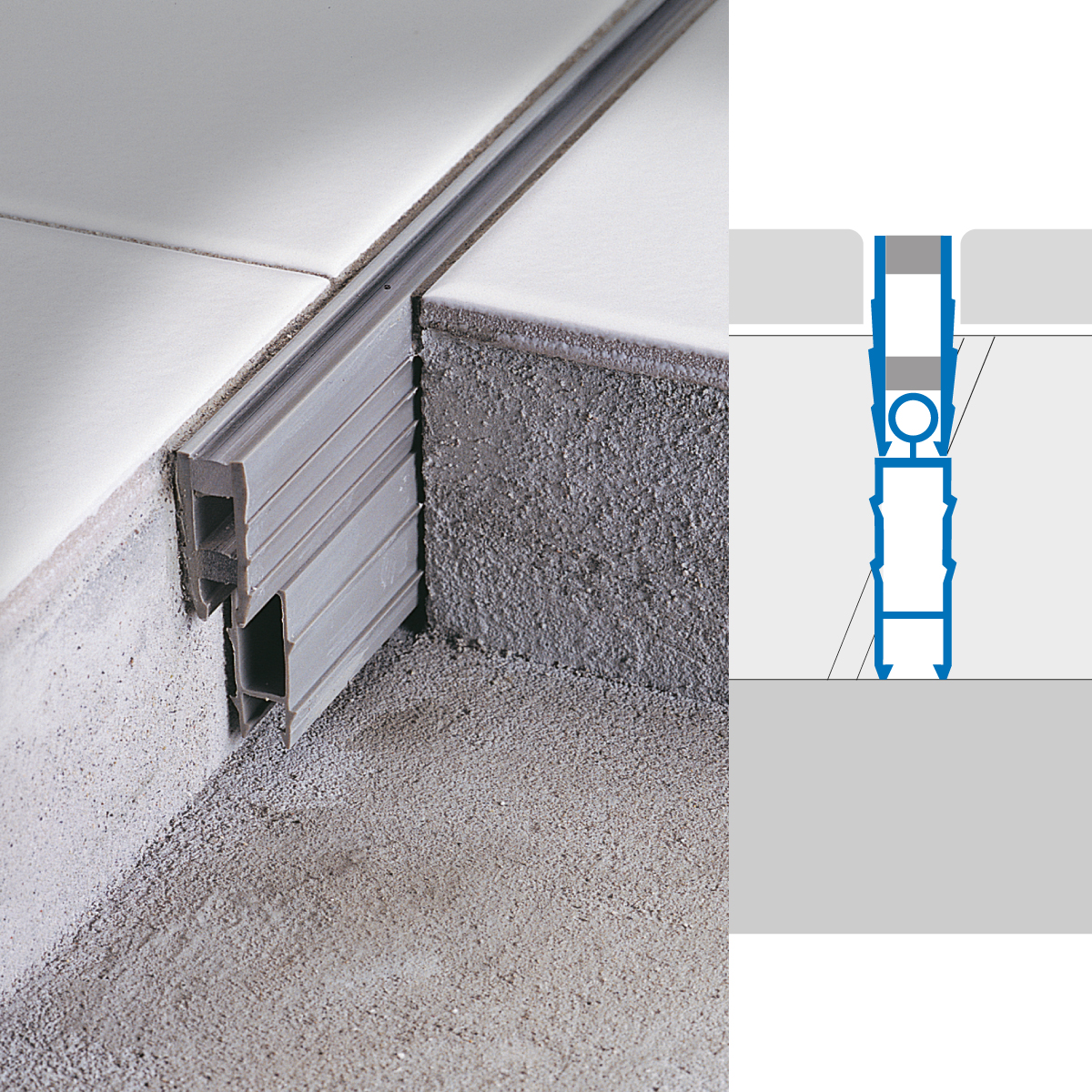
Movement joints are superficial joints (at the floor level), placed in correspondence with the underlying substrate. The superficial joint must be realized in exact correspondence with the joint of the substrate, even just a 5cm difference between the 2 joints can cause tile breakage or tenting (you may hear a “popping” sound). We recommend placing movement joints around areas with a maximum side length of 4 meters (16m2).
Was this helpful you for solve?
-
No, when the membrane is used as a decoupling system—to prevent tile breakage when installing “large-format” tiles, when the existing subfloor is not perfectly level, or when the floor is expected to be subjected to particular stresses—it is sufficient, before installing the tiles, to cover the entire surface with the membrane, placing the sheets side by side (without overlapping them).
However, when Floortec is also used as a secondary waterproofing layer (to protect the screed), it is necessary to seal the joints with the Foiltec waterproofing tape, taking care to apply the adhesive in a full-bed application over the membrane’s joint areas, carefully pressing the tape into place and overlapping it with Floortec by at least 5 cm. The same procedure must be followed along the entire perimeter to seal the joints between the floor and wall cladding, bonding half of the strip to the membrane and the other half to the wall. When used in combination with Bordertec drip-edge profiles, align Floortec with the profile’s cut edge and then seal the cut edge to the membrane using the waterproofing strip, adhering half of it to the membrane and half to the profile.
Was this helpful you for solve?